
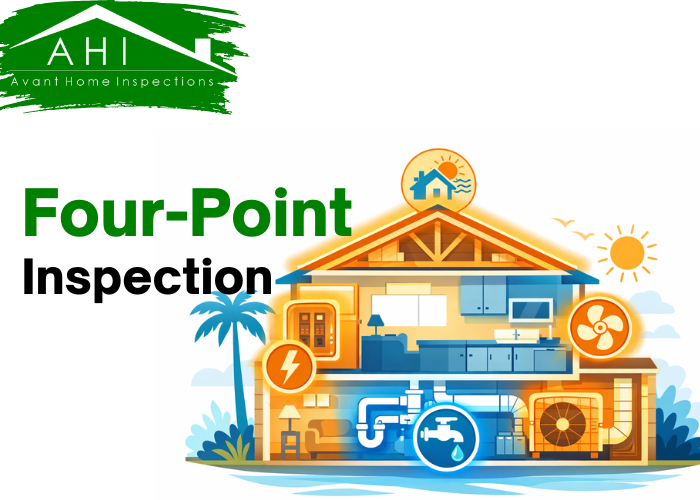
Florida’s subtropical climate is as hard on homes as it is beautiful. Intense heat, relentless humidity, salt air, and hurricane-force winds put tremendous stress on a home’s critical systems year after year. Insurance companies know this — and many will refuse to issue or renew a homeowner’s policy without proof that your home’s key systems are in acceptable condition.
That proof comes in the form of a four-point inspection: a focused assessment of the four major systems most likely to generate an insurance claim. Unlike a general home inspection, which covers dozens of components, a four-point inspection is quick, purposeful, and increasingly required — especially for older homes.
The four systems under review
The inspection gets its name from the four areas it evaluates. Each one represents a category of risk that insurers pay close attention to.
Electrical System
Panel brand, wiring type, capacity, and known fire hazards like aluminum wiring or Federal Pacific panels.
Plumbing System
Pipe materials (copper, CPVC, polybutylene), supply and drain lines, visible leaks, and water heater age.
HVAC System
Age, condition, and functionality of heating and cooling units — critical in Florida’s year-round heat.
Roof
Material, estimated remaining life, condition, and any visible damage, deterioration, or storm wear.
Why these four?These systems account for the majority of homeowner insurance claims in Florida. A failing roof lets in water. Faulty wiring starts fires. Old plumbing bursts. Inefficient HVAC can mask larger structural moisture problems. Insurers want to know the risk before they take it on.
Who typically needs one
While any homeowner can request a four-point inspection, Florida insurers most commonly require one in these situations:
Older homes
Most insurers require a four-point inspection for homes that are 25–30 years old or older, though some carriers now request them for homes as young as 15 years.
New policy applications
When shopping for a new homeowner’s insurance policy in Florida — especially if changing providers — an insurer may require the inspection before binding coverage.
Policy renewals
Some carriers request an updated four-point inspection at renewal, particularly if the home has aged into a higher-risk category since the last assessment.
Home sales
Buyers obtaining homeowner’s insurance on a home built before the mid-1990s will almost always encounter this requirement from their insurer before closing.
What happens during the inspection
A four-point inspection is significantly narrower in scope than a standard home inspection. A licensed inspector will visually assess each of the four systems, take photographs, and complete a standardized report form — typically the Citizens Property Insurance form, which most Florida insurers accept.
The inspector is not testing every outlet or running every faucet. The goal is to identify the type, age, and apparent condition of each system, and flag any known issues that pose a safety or liability concern.
The whole process usually takes 45 minutes to an hour for a typical Florida home, and the report is delivered within 24–48 hours.
Common red flags insurers watch forPolybutylene or galvanized steel pipes, knob-and-tube or aluminum wiring, Federal Pacific or Zinsco electrical panels, roofs over 15–20 years old, and HVAC systems beyond their expected lifespan. Any of these may result in denied coverage, required repairs, or a higher premium.
How to prepare as a homeowner
A little preparation goes a long way toward a clean report. Here’s what to have ready before your inspector arrives:
Locate your electrical panel and ensure it’s accessible — move any items stored in front of it.
Know the age and brand of your HVAC unit. The data plate is usually on the side of the air handler or outdoor compressor.
Have records of any roof replacement handy, including permits and contractor documentation — this can extend your insurable roof life in the insurer’s eyes.
Address any visible plumbing leaks under sinks or around the water heater before the inspection date.
Ensure attic access is clear — the inspector will want to visually confirm roof decking and any visible wiring or plumbing above.
Four-point vs. wind mitigation: knowing the difference
Florida homeowners are often asked for two separate inspection reports, and they’re easy to confuse. A four-point inspection evaluates your home’s condition for insurability purposes. A wind mitigation inspection, on the other hand, documents hurricane-resistance features — roof shape, roof-to-wall connections, opening protection — and can earn you significant premium discounts.
Both inspections can typically be performed during the same visit, saving you time and cost. If you’re ordering one, ask your inspector whether the other makes sense at the same time.
The cost of not having one
Skipping or delaying a four-point inspection rarely saves money. Insurers who can’t verify the condition of your home’s critical systems may decline to insure it at all — or offer coverage at substantially higher rates through Florida’s Citizens Insurance market of last resort.
More importantly, an inspection gives you a clear-eyed view of your home’s actual condition. If a system is flagged, you’re better positioned to address it proactively — before a claim, before a sale falls apart, and before a minor issue becomes a major one.
Bottom lineIn Florida’s challenging insurance environment, a four-point inspection is less a formality and more a necessity. Think of it as a wellness check for the systems your home — and your insurer — depends on most.